| |||
 |  |  | |
 |  | ||
 |
 | ||
 |  | ||
 |  | ||
Written by Paul D. Race for Family Garden Trains(tm)
 |
Which Scale Should I Model?This is the ninth time I have updated this article. As I mentioned the last time, most of the questions and so-called controversies that prompted me to write the orginal article are all but moot. But folks who are new the to hobby still get confused, and occasionally they run into some hardliner that tells them they're doing it wrong. So we're updating the article again to reflect the realities of 2019 and beyond.First of all, if you have trains running in your yard at all, that puts you way ahead of the people who complain the loudest about things like the scale of your trains. As it turns out, most of them don't even have trains running in their yards, and at least three of the most vocal own businesses that would be better off if the company they're complaining about folded. You can't assume that such people have your best interest at heart. Nobody has a right to tell you what trains to use, how to power them, or anything else, and the people who think they do are wrong far more often than they're right. In fact I started the Family Garden Trains web page because so much wrong information was being published about the hobby, and so many people insisted their way was the only "right way" to do things. This article was one of many I wrote specifically to "set the record straight" on some topic. In all the years since I wrote it, I've never had one person prove me wrong on any of its content. However, I realized that I was wrong in presenting scale and gauge issues as though they are really all that important to the new garden railroader. Here's my apology for all the people that started overthinking their train choices because of what I wrote here. After over thirty years in the hobby, I realize that the success or failure of any backyard railroad has far more to do with whether it is attractive, reliable, and maintainable than what kind of trains run on it. In other words, which scale trains you run is a minor issue, almost a non-issue compared to things like:
In other words, there are many more important things to focus on, whether you're starting out, or whether you've been doing it for decades like I have. Frankly, trains are only one part of the railroad, sharing the spotlight with miniature trees, groundcovers, water features, structures, and more. And they all run on the same track, as long as the curves are wide enough. So what if the first train you buy winds up not being exactly the kind of train you settle on later? As long as the landscaping and infrastructure of your railroad is sound, you can take that train off the tracks and put another train on the tracks any time you want. The Short Version The truth is that no scale is intrinsically better than another. Unless you're going to build all of your own trains, the real question is what kind of railroad do you want to model? That will tell you what brands of trains you should consider. Then, when you buy any brand of trains, you will automatically be modeling in the scale that brand has chosen. Here's the really important thing - if you have a good track plan and a well-designed, easily maintained railroad, it doesn't matter what trains you run, as long as you avoid parking trains that are radically different next to each other or some such. Deciding on a scale because someone tells you that one scale is intrinsically better than another is entirely backwards.
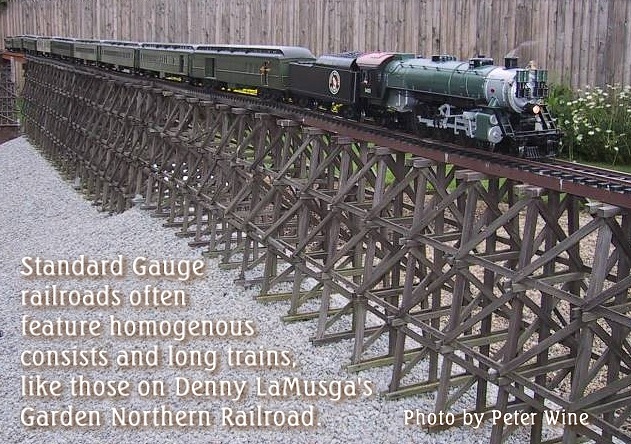
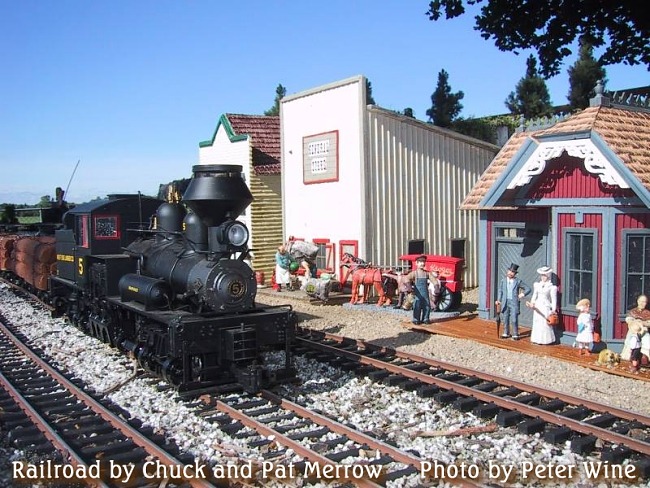
I mention Traction (streetcars, interurbans, etc.) above, because one manufacturer (HLW) has a very nice line of old-timey streetcars that are 1/24 the size of the real thing. If you want to model an urban landscape using streetcars, etc., they're a very good place to start. HLW also makes some very nice old-timey trains in the same scale. Also, if you want to model a little industrial railroad, like a lumber or coal company, you will probably wind up using products from Bachmann, LGB, or HLW What People Mean When They Tell You You're Using the Wrong ScaleWhat they're really saying is that the trains that suit your expectations don't suit theirs. Yes, there are a couple scales that are more "accurate" in terms of whether the trains exactly replicate the ratio of the size of the trains to the width of the track. But relatively few products are made in those scales.If you choose to use run trains in scales that have a lot more choices, (and are maybe 10% larger or smaller than they "should be" for the width of the track), nobody will know or care (except folks who like whining about the way other people enjoy their hobbies). I can state this authoritatively, having held twelve open railroads over the years, entertaining hundreds of people. In all that time, I've only encountered one person who was a jerk about my choice of models - and that was about my buildings being made of plastic instead of wood. Go figure. If a self-proclaimed expert comes upon an attractive, working garden railroad, and the first thing that draws his attention is that you're using a brand of trains he doesn't like (but most fellow hobbyists do), he has bigger problems than you. The only place it gets "dicey" is if you try to mix pieces from different scales in the same train. Sometimes it works, ironically, but sometimes it doesn't. Other than that, do as you wish. A Good Garden Railroad Can Support any Scale of Garden TrainsEven more telling is that almost everybody uses the same buildings and accessories, no matter what scale they're modeling in - even the people who complain about other people's choices of rolling stock. That's another reason scale and gauge issues in garden railroading have been overstated. 90% of the garden railroads I've visited could run any scale trains they wanted any day of the week, and they would all look just fine with their landscapes and accessories. In other words, if you buy a starter set in one scale, and later decide you'd rather use models from a manufacturer who uses a different scale, you can keep your first set and run it on alternate days. You can probably even run both at the same time, although parking them next to each other might look silly. Who decides that? You do. Frankly, I have come to the point in my life where the kind of trains I run that day may depend on who's coming over. The "serious" indoor railroaders often get to see the mainline trains from AristoCraft and similar brands that model/modeled big mainline railroads like NYC, PRR, and N&W. The people who just want to see something "quaint' often get to see the LGB and Bachmann "old-timey" trains in D&RG, V&T, or similar colors. The people who come over during the holiday season will generally see trains that are in bright Christmas colors that never ran in the real world. And do you know what? Nobody complains. Ever. Why Was Scale and Gauge Ever an Issue in Garden Railroading?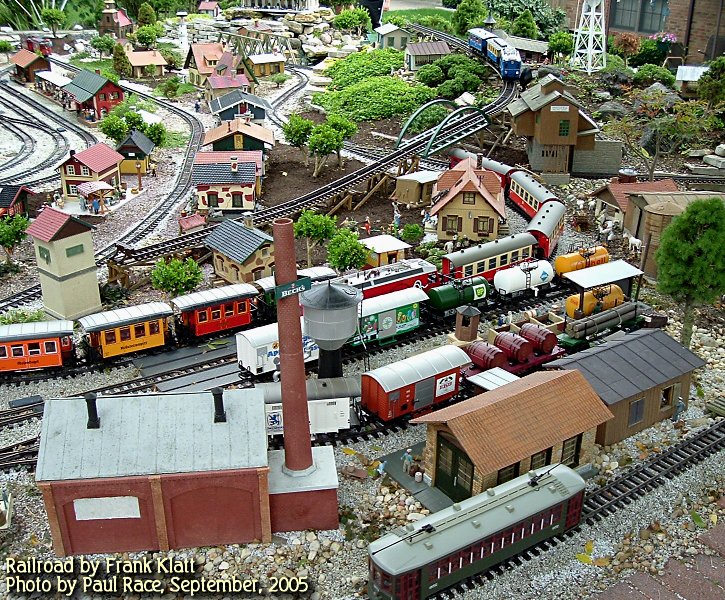 It wasn't when modern garden railroading started out. There was only one manufacturer (LGB), and they made trains in only one scale (more or less). Frank Klatt's railroad, shown to the right, was a great example of the first generation of modern garden railroading, using LGB's Euro-inspired trains and POLA's Euro-inspired buildings. It wasn't when modern garden railroading started out. There was only one manufacturer (LGB), and they made trains in only one scale (more or less). Frank Klatt's railroad, shown to the right, was a great example of the first generation of modern garden railroading, using LGB's Euro-inspired trains and POLA's Euro-inspired buildings.
LGB's trains ran on rails that were 45mm apart. Their first, European-style trains represented trains that were running on rails that were only a meter apart. Since 45mm goes into a meter 22.5 times, LGB designed their trains to be 1/22.5 the size of the real things. Hobbyists express that scale as 1:22.5. But years went by before anyone started making garden trains that looked like they belonged in North America instead of the Alps. The first serious US-style models were built by Delton Locomotive Works. Delton's designers chose to make their trains 1/24th the size of the real thing (or 1:24). That way, hobbyists would have access to a whole lot of accessories, from dollhouse and model automobile manufacturers. And, technically, they were the right scale for 42" gauge, which a handful of real-world railroads actually used. Delton did not have the deep pockets of the other manufacturers, however. When LGB introduced their US-style line, using the same scale as their European trains (1:22.5), the trains were simply bigger and more impressive. (Remember, the higher the scale ratio the smaller the trains.) 1:24 trains now survive mostly in the HLW products, which are still being designed by a fellow who designed many of the best-selling Delton products. Soon after LGB introduced their American-style trains, Bachmann, long an HO and N supplier, introduced their own garden trains. Their "Big Hauler" entry-level trains were in the same scale as LGB's, so for the most part they looked good with LGB trains. But American railfans wanted more modern trains, the kind of big, mainline trains that - in the real world - ran on tracks that were 56.5 inches apart, otherwise known as "standard gauge." When the Polk hobby shop owners tried introducing US mainline-style trains on 45mm track, they had to make the models to a smaller scale, or they wouldn't have fit on the track. They could have chosen 1:32. After all, 45mm = 1.774" and that goes into 56.5" 31.8 times. But the Polks didn't think 1:32 trains showed up well outdoors, so they made them about ten percent larger - 1:29. They called their trains "AristoCraft." A few years later, Charles Ro's USA Trains went to 1:29 as well. Though AristoCraft has gone out of business, USA Trains is still going strong, so 1:29 is alive and well. Here's where the confusion started:
Toward the end of the first huge growth period, MTH (formerly Mikes Train House) introduced a line of 1:32 trains. Like AristoCraft and USA Trains, the MTH 1:32 trains modeled full-sized mainline trains that ran on rails 56.5" apart. Because the manufacturers chose to model in 1:32, MTH's garden trains were about 10% smaller than AristoCraft and USA Trains, and the two didn't always look right together. Though a few small suppliers made pieces that would work with MTH trains, for some years, MTH was the only major supplier of 1:32 trains. Nowaday's PIKO's trains are close enough to look good with most MTH pieces. The following diagram shows how choosing the kind of railroad you are considering building drives your choice of manufacturers, and how, consequently, scale is "way down the list" of decisions you have to make. 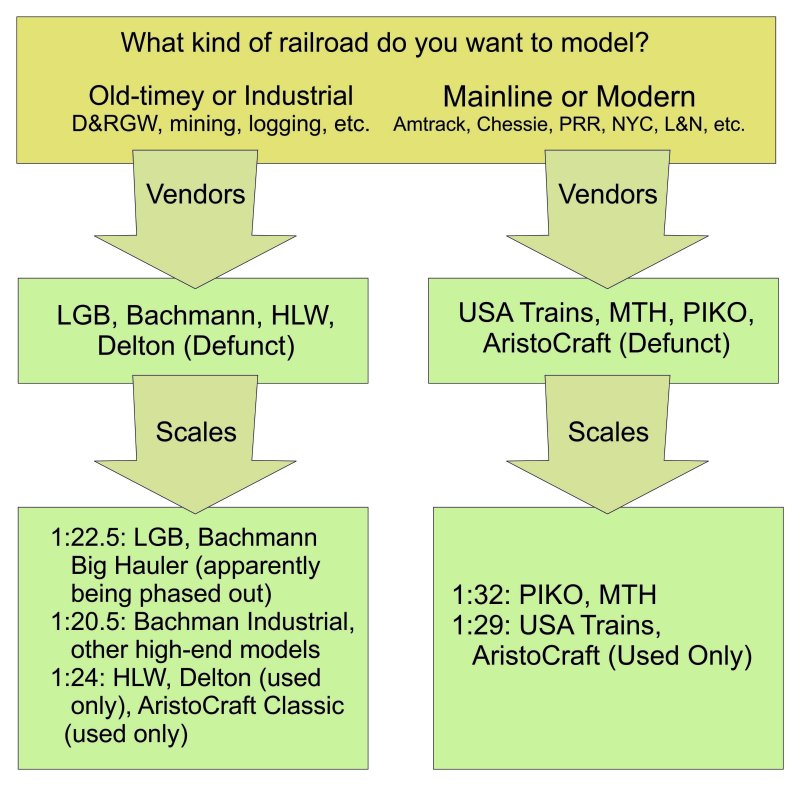
Several other manufacturers have come into the market, offered a few pieces, and got back out or gone bankrupt. But this lists the brands that are easiest to build a railroad around in 2019. Again, this will almost certainly change. Please keep in mind that NONE of these manufacturers claimed their products would all play together nicely with anyone elses. All of them were trying to support a growing hobby, and none of them deserve censure for not living up to some individual's expectations. How I Got Into Quicksand and Worked My Way Out - This may seem hard to believe nowadays, but back in the early 1980s when I got into the hobby with three train sets that have long since been discontinued, I couldn't mention that I was considering a new purchase without somebody chiding me for buying the "wrong" product. In the meantime, with a tiny budget and no local means of checking out any of the trains I was interested in, I wound up ordering used pieces from online auctions, etc., setting them side-by-side, trying them out, measuring them, and so on. And I realized that the self-appointed experts were universally "full of it." Some of my hands-on research found its way into the earliest version of this article. Some of them found their way into a supplementary article "Mixing and Matching Large Scale Cars/Sample Car Measurements") Things Are Way Better Now - Years later (thanks, in part to the earliest versions of this article and other thought leaders recognizing the same problems I did), most garden railroaders realize that arguing over things like scales, coupler heights, flange depths, etc. is self defeating. After all, our competition for the attention of new families is not trains in the "wrong" scale. It's video games, 12-month sports leagues, and all the other 21st-century issues that prevent youngsters and their families from spending time on creative activities that build the heart and sooth the soul, such as music, art, and - yes - gardening and model trains. Scale Isn't The Most Important Issue - Even though this article is about the scale of the trains you may choose to use, I have to repeat my observation (after decades in the hobby), that a good, maintainable track plan with wide curves and an attractive setting are far more important long-term to most garden railroading families than what trains are running on those tracks. Naysayers aside, lots of folks who started out with European trains have switched to US-style trains and vice versa. Lots of folks who started out with narrow gauge trains have switched to standard gauge, and vice versa. Some folks, like me, run different kinds of trains on different days, as the mood strikes us.The important thing is to get started and to build a railroad that will give you years of enjoyment. (Our Construction articles will help you with that) So consider this page as a general guideline, and a reference to check back with in the future, but don't lay awake nights fretting about which train to start with. Go out in the yard and figure out where you want to start digging, come up with a plan, price lumber and supplies, and then buy a garden train set you like (our Starter Set page will give you some idea of your current choices.) Thanks - Even though some of our conversations took place years ago, I will still extend my thanks to Lewis Polk (former head of AristoCraft), Phil Jensen (designer for Delton and HLW), David Buffington (former representative of LGB), Andy Edleman (MTH marketeer) and Vance Bass (GR historian and a long time garden railroader) for their assistance in "cross-checking" the facts. I have also received help with minor questions from most of the other major manufacturers listed. If you see any historical, numerical, or other factual discrepancies, please let me know. Thank you very much for your help in maintaining this resource. Paul Appendix: Detail ChartThe following chart provides a little more detail about the choices you face if you are trying to find a major manufacturer that supports your railroading interests. The fact that some of the boxes are blank or nearly blank just shows where the Large Scale manufacturing base is at the moment. The picture could change quite a bit in the next few years as manufacturers continue to come and go. So this chart is nothing but a snapshot of the decisions you will face in the spring of 2019.
Note: Family Garden Trains?, Garden Train Store?, Big Christmas Trains?, BIG Indoor Trains?, and BIG Train Store? Family Garden Trains is a participant in the Amazon Services LLC Associates Program, an affiliate advertising program For more information, please contact us 

|
|||||